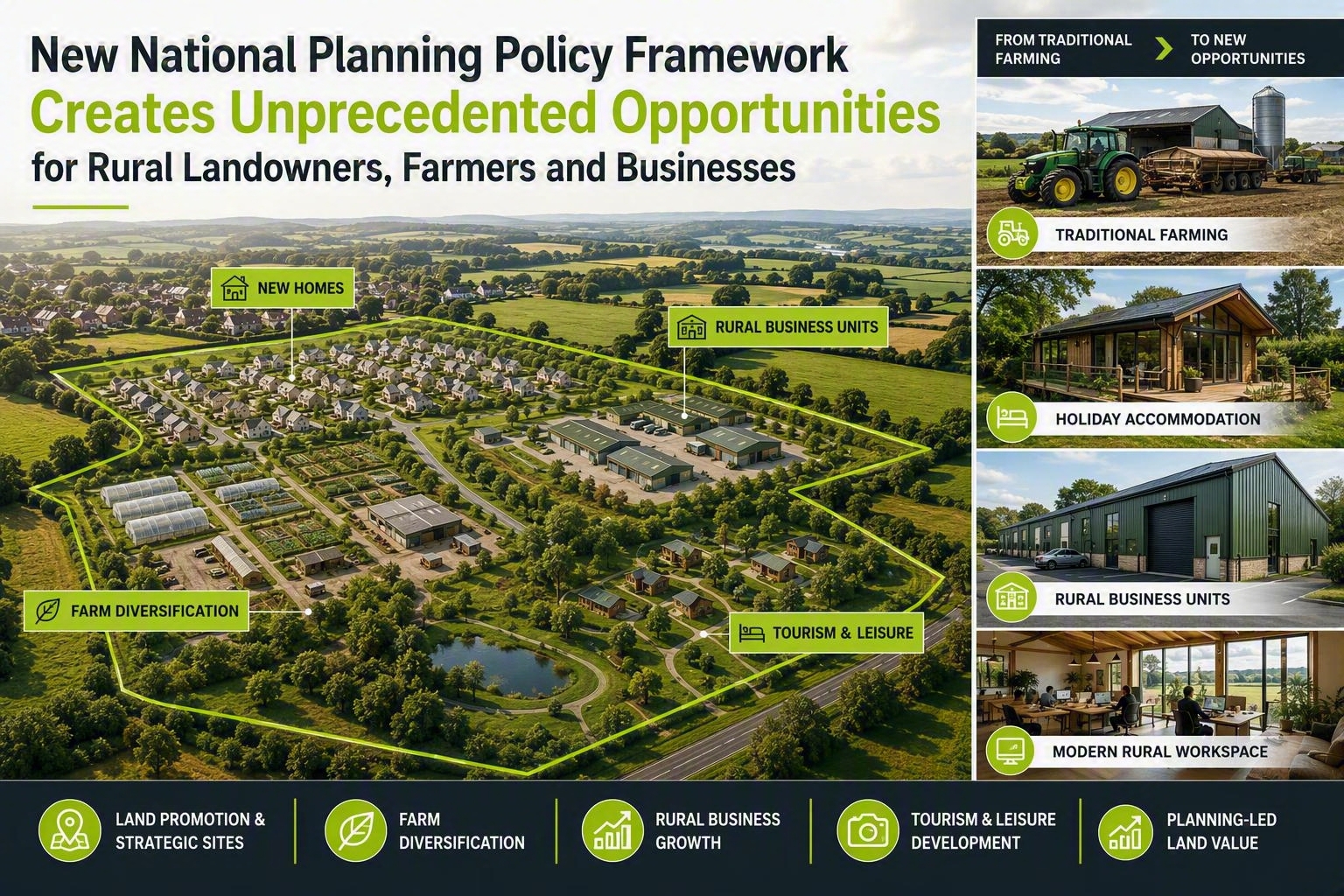
New National Planning Policy Framework Creates Unprecedented Opportunities for Rural Landowners, Farmers and Businesses
New National Planning Policy Framework Creates Unprecedented Opportunities for Rural Landowners, Farmers and Businesses
Waypoint Planning’s Dan Hewett takes a look into the implications of the new National Planning Policy Framework for rural landowners, farmers and businesses.
The planning landscape has changed. The shift is monumental. It is foundational to the way planning decisions will be made from now on. Or more accurately until a future Government makes a sharp U-turn or waters it down. In which case, the message I am conveying is possibly even more urgent and time critical.
Having spent over 20 years trying to progress development proposals in rural areas under the previous iterations of the National Planning Policy Framework (NPPF), the changes are quite remarkable, and I am genuinely surprised that they made it through the consultation stage undiluted.
The recent publication of the revised NPPF has introduced a new approach to development in the countryside, providing stronger in-principle support for a wide range of rural development proposals outside settlement boundaries. New Policy S5 ‘Principle of Development Outside Settlements’ (Oh it’s a belter!), identifies several forms of development that should be approved unless the benefits are substantially outweighed by adverse effects when assessed against the other national planning policies.
For rural landowners, farmers, estates and businesses, this presents a significant opportunity to revisit development aspirations that may previously have been considered difficult to achieve.
A More Positive Approach to Rural Development
This new policy, which I am unashamedly focusing on, recognises that development outside settlements can play an important role in supporting the rural economy, improving infrastructure, delivering homes and helping businesses grow.
National policy now provides direct support for the following in such locations:
- Agricultural, horticultural and forestry development
- Development for rural businesses and services, including tourism
- The reuse, extension, alteration or replacement of an existing building
- The redevelopment of previously developed land
- Limited infilling within groups of houses
- Outdoor sport and recreation
- Engineering operations and infrastructure (including for transport, energy, water, reservoirs and telecommunications)
- Renewable energy and energy infrastructure
- Mineral extraction and processing
- Nature conservation, restoration and biodiversity enhancement projects
- National defence and security uses
For farms and rural businesses seeking to modernise, diversify or invest in their operations, the principle of development is now considerably clearer than under previous policy approaches. This is big. It is likely to be too much for local authorities to comprehend in the short term. Only time will tell whether they try to cling to their own locally adopted planning policies, regardless of whether they align with the new national ones.
Stronger Policy Support for Farm Diversification and Rural Enterprise
Perhaps most importantly for many rural businesses, the glorious Policy S5 specifically supports:
Development for rural businesses and services, including tourism, where a location outside settlements is shown to be necessary.
This could include proposals such as:
- Farm shops and farm-based retail
- Holiday accommodation and glamping sites
- Wedding and events venues
- Rural cafés and restaurants
- Equestrian facilities
- Visitor attractions
- Commercial units supporting rural enterprise
- Storage, processing and distribution facilities linked to agricultural businesses
Many successful rural enterprises rely upon being located within the countryside. The revised NPPF now recognises this reality more explicitly than ever before.
Existing Buildings Could Hold Untapped Potential
Many farms and estates contain buildings that are underutilised, redundant or no longer fit for their original purpose.
The new policy supports:
- The reuse of existing buildings
- Extensions and alterations
- Replacement buildings
- Modernisation of rural premises
Provided the building is lawful, of permanent and substantial construction, opportunities may exist to secure planning permission for alternative commercial, tourism or employment uses.
For many landowners, existing buildings could now represent valuable assets capable of supporting future diversification and investment. This is not necessarily new, however, the bar has been lowered and previous negative positions taken by local authorities will be easier to challenge.
Small-Scale Housing Opportunities in Rural Areas
The new policy also supports limited infilling within groups of houses.
For landowners controlling land within villages, hamlets or clusters of existing development, sites that have historically fallen outside settlement boundaries may now warrant a fresh appraisal.
Many small parcels of land that were previously overlooked or rejected could potentially benefit from this more favourable policy context.
New Opportunities for Residential Development Near Railway Stations
One of the most significant changes within the magnificent Policy S5 is the introduction of support for certain residential and mixed-use developments located outside settlements.
The policy supports development that:
- Is within reasonable walking distance of a well-connected railway station;
- Is physically well-related to the station or the settlement it serves; and
- Can be accommodated by existing or proposed infrastructure.
This could create substantial opportunities for landowners promoting sites adjacent to railway stations and sustainable transport hubs.
Sites previously regarded as countryside locations may now have a much stronger policy basis where they can demonstrate good accessibility and sustainable transport credentials.
Housing Land Supply Shortfalls Could Create New Development Opportunities
The new NPPF goes even further by supporting development that addresses an evidenced unmet housing need.
Importantly, this includes situations where a Local Planning Authority:
- Cannot demonstrate a five-year supply of deliverable housing sites; or
- Scores below 75% in the most recent Housing Delivery Test.
Where housing need can be demonstrated, the policy supports development that is:
- Physically well-related to an existing settlement;
- Of a scale that available infrastructure can accommodate; and
- Appropriate to its location and context.
For many landowners with land on the edge of villages, market towns and larger settlements, this could present a significant opportunity to revisit sites that may have been previously discounted for development.
The implications for site promotion, strategic land opportunities and residential development potential could be substantial across many rural authorities.
Is it Time to Review Your Land Portfolio?
Yes. The revised NPPF represents one of the most significant changes to the planning system in many years. Local planning authorities will now be required to assess development proposals against this new national framework, while older local plan policies that conflict with national policy should carry reduced weight in decision-making.
That means sites which may have:
- Received negative planning advice in the past;
- Been rejected at the Pre-Application stage;
- Failed to gain allocation through a Local Plan review; or
- Simply never been promoted,
may now deserve a fresh review.
How Waypoint Planning Can Help
At Waypoint Planning, we specialise in helping rural landowners, farmers, estates and businesses unlock the potential of their land and property assets.
Our team can assist with:
- Strategic land promotion
- Farm diversification projects
- Tourism and leisure developments
- Rural business growth
- Building conversions and redevelopment
- Housing and mixed-use opportunities
- Site appraisals and feasibility studies
- Planning applications and appeals
Whether you own a redundant farm building, a parcel of land on the edge of a village, a brownfield site, or land near a railway station, there may now be stronger national policy support than ever before. The only unknown is how long this will last.
For further information please get in touch with our Planning Consultancy Team to discuss on advice@waypointplanning.co.uk or 01284 700727.