England’s First National Scheme of Delegation
England's First National Scheme of Delegation
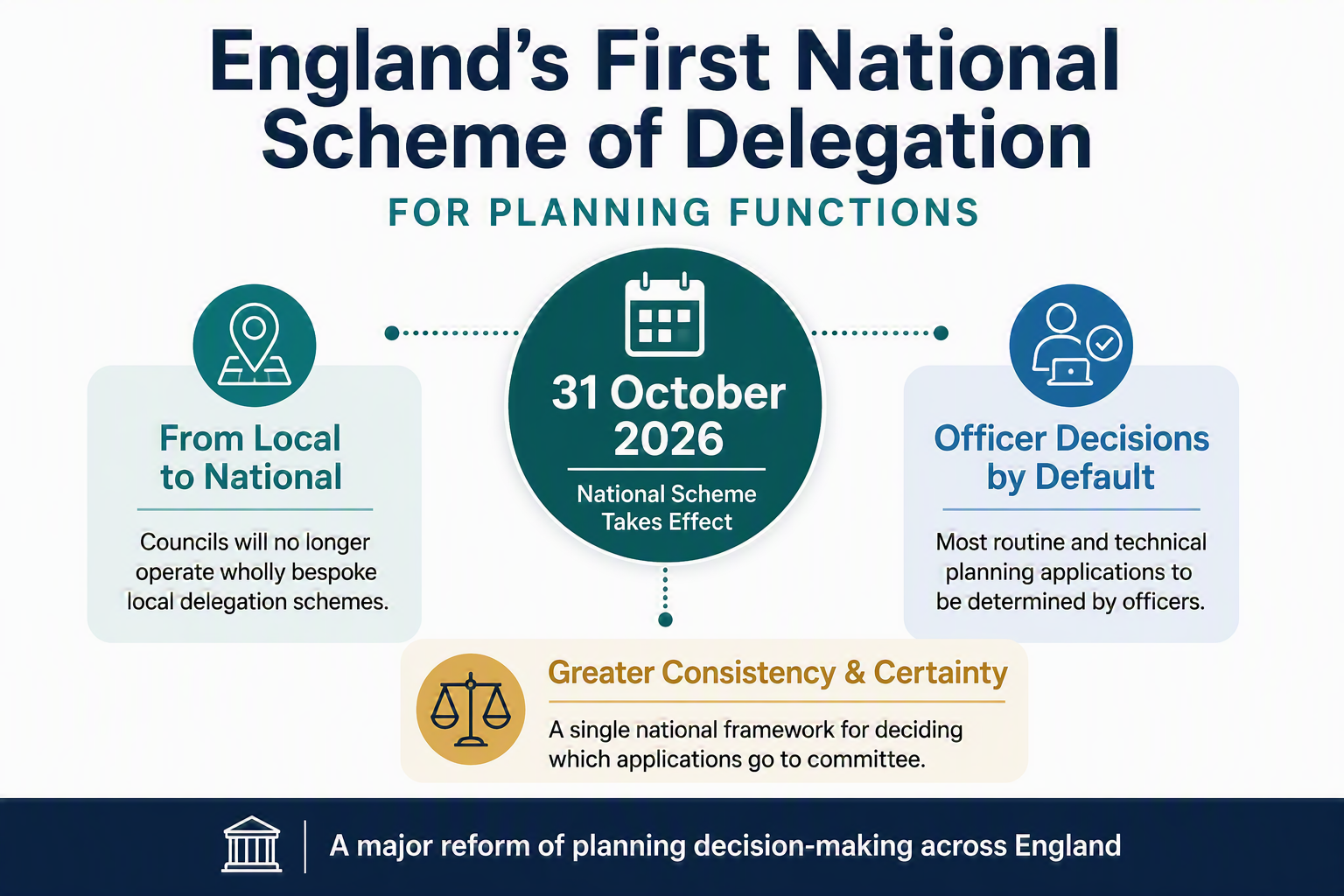
From 31st October 2026, decision making for planning across England will see significant changes due to the National Scheme of Delegation. These reforms will change which applications will be delegated to officers and which are determined by planning committee.
One major change is that some applications will now be unable to go before a planning committee by law. The new scheme divides applications into two categories, Schedule 1 and Schedule 2. Schedule 1 applications will be unable, lawfully, to be determined by committee and include householder, minor commercial and minor residential, among others. This represents a shift from using locally determined delegation arrangements towards a nationally consistent decision- making framework.
The removal of member call-ins for applications falling within nationally prescribed categories represents a significant change, placing greater emphasis on planning policy, technical evidence and professional planning judgement.
Schedule 2 applications may still be determined by committee, but only where specified criteria are met, including circumstances where proposals raise significant economic, social or environmental issues for the local area, or a significant planning matter having regard to the development plan and other material considerations. Importantly, the guidance makes clear that officer determination should remain the default position, with referral to committee intended to be exceptional rather than routine. This reflects the Government’s intention that planning committees focus on genuinely significant planning issues rather than applications which simply attract local interest or controversy.
The guidance also suggests that proposals which broadly accord with adopted planning policy, or where technical concerns have been satisfactorily addressed, are unlikely to merit committee involvement. Schedule 2 includes Listed Building Consent applications, major commercial and residential applications, and large reserved matters applications.
As a result, planning officers will play an increasingly central role in decision-making under a more officer-led national planning system. Referral to committee will require agreement between the Planning Committee Chair and a senior planning officer. If no agreement is reached, the officer’s decision will prevail, placing greater emphasis on professional judgement.
For applicants, this means greater emphasis on planning policy, technical evidence, early engagement, and a robust planning case.
Simply put, far fewer applications will reach committee, and those that do will need to demonstrate genuine planning significance rather than merely attracting local interest.
For further information please get in touch with our Planning Consultancy Team to discuss on advice@waypointplanning.co.uk or 01284 700727.