Spatial Development Strategies – A Spring 2026 Update
Spatial Development Strategies – A Spring 2026 Update
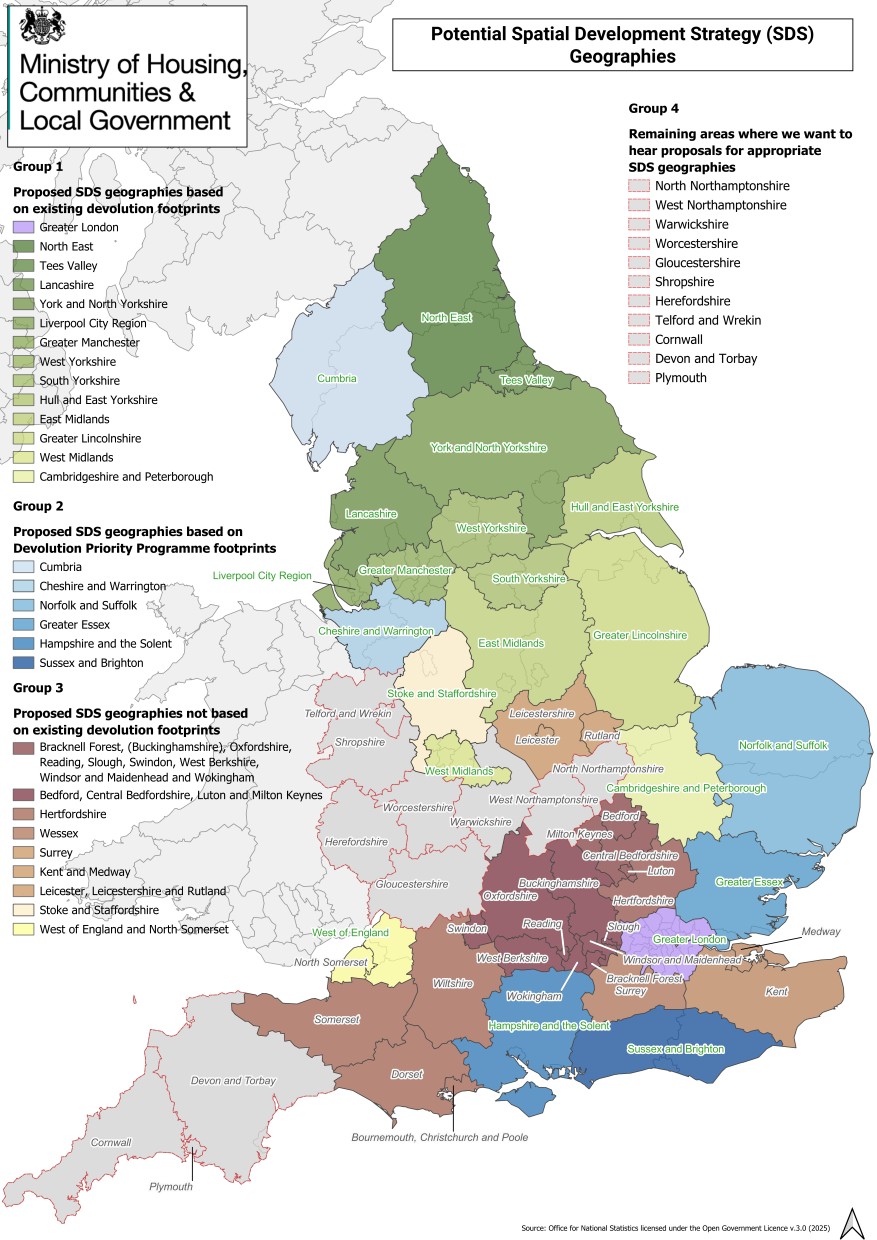
Following the Government’s recent publication of the Spatial Development Strategy consultation paper on 12th February 2026, it is the first time that the Government have given an insight into the geography of the forthcoming formation of Spatial Development Strategies across England.
Spatial Development Strategies (SDS) look to be a key instrument in enabling a more effective delivery of economic growth, strategic infrastructure and crucially housing, in an identified SDS plan area over a 20-year period. These strategies look to be implemented across future Spatial Development Authorities which the consultation paper proposes, with 3 key legislative tools unlocking these changes.
Firstly, the Planning and Infrastructure Act 2025 introduced powers for the Government to create Spatial Planning Boards which look to guide local authorities in their newfound duty to develop SDS plans within their legislative boundaries, taking inspiration from London’s Spatial Development Strategy. The Act also provides a duty for the examination of SDSs with consecutive 5-year review periods to ensure effective delivery and implementation across the plan areas.
The SDSs will look to be implemented across these geographies through the formation of Strategic Authorities (in areas where they are not already established), with the emerging English Devolution and Community Empowerment Bill, another mechanism to enable SDS’ operation, setting the framework for the new layers of governance. This emerging legislation will look to provide Strategic Authorities with planning and development decision-making powers to ensure that the policies and vision of the SDSs are being implemented.
Finally, the 2025 Draft National Planning Policy Framework provides a clear framework for the preparation of SDSs (Policy PM1), the role that Local Plans will play in supporting the delivery of SDSs in their area (Policy PM2), and the checks in place to ensure that SDSs are positive and appropriately designed in accordance with national policy (Policy PM14). It provides another mechanism to facilitate the shift in decision-making powers toward Strategic Authorities.
These changes in the planning landscape are seen to be increasingly common within many European Union nations, where a strong regional-based level of decision-making in planning is largely seen to be evolving at an effective rate. Where these nations look to continue on their pathway of reflective and improving regional development, it can be viewed that the UK Government’s decision to implement this renewed scale of development policy is largely aligned with many of our European neighbours.
Only time will tell how the implementation of these three key pieces of legislation will materialise in the arena of planning and development however it is a clear indication that the incumbent era of Local Planning Authorities having complete control over shaping the future of their district’s is nearing its end.
Image Credit.
1. Unsplash
2. Open Government License